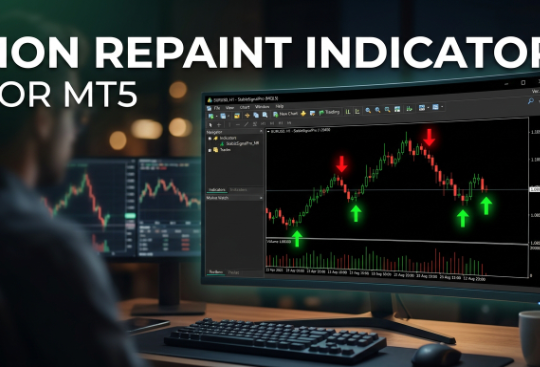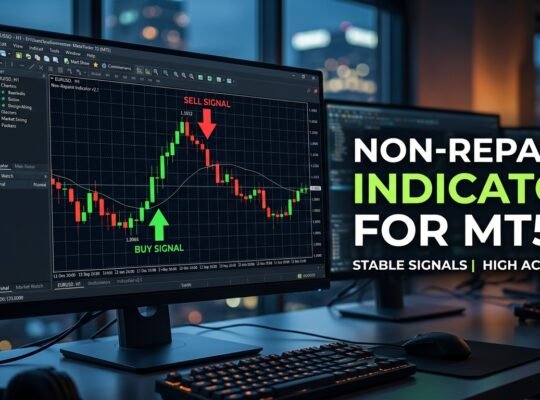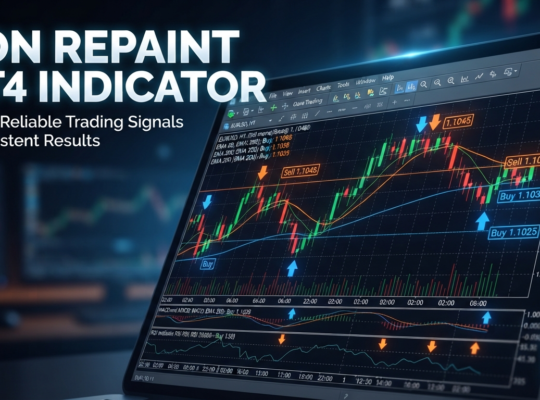
Ask any trader who’s used a handful of arrow-based signal tools, and they’ll tell you the same thing: most of them look incredible on a historical chart and fall apart the moment real money is on the line. That gap almost always comes down to one issue — repainting. This piece digs into what a genuine non-repaint buy sell signal indicator for MT4 looks like, why so few tools actually qualify, and how the BD Indicator was built to close that trust gap.
The Buy/Sell Arrow Problem Nobody Warns You About
Arrow-based indicators are popular for a simple reason — they remove the guesswork. An up arrow means buy, a down arrow means sell, and there’s no ambiguity in between. That simplicity is exactly why so many indicator developers lean on the format, and unfortunately, why so many of them cut corners on how those arrows are actually calculated.
A repainting arrow indicator will often display a signal on a candle, only to erase or relocate it once a few more bars close and its underlying formula recalculates with new information. Scroll back through history and the chart looks flawless — every arrow lines up with a perfect turning point. Trade it in real time, though, and you’ll notice those same “perfect” arrows never quite show up when you actually need them, because the tool was quietly editing its own past.
Why This Matters More Than Most Traders Realize
The danger here isn’t just a bad trade here and there — it’s a completely false sense of confidence. A trader who backtests a repainting indicator and sees an 80% win rate has no real data at all, because that win rate was generated with the benefit of hindsight the indicator didn’t actually have in real time. This is one of the most common reasons promising-looking systems fail the moment they go live, and it’s a pattern worth understanding before trusting any forex indicators with real capital.
How the BD Indicator Solves the Repaint Problem
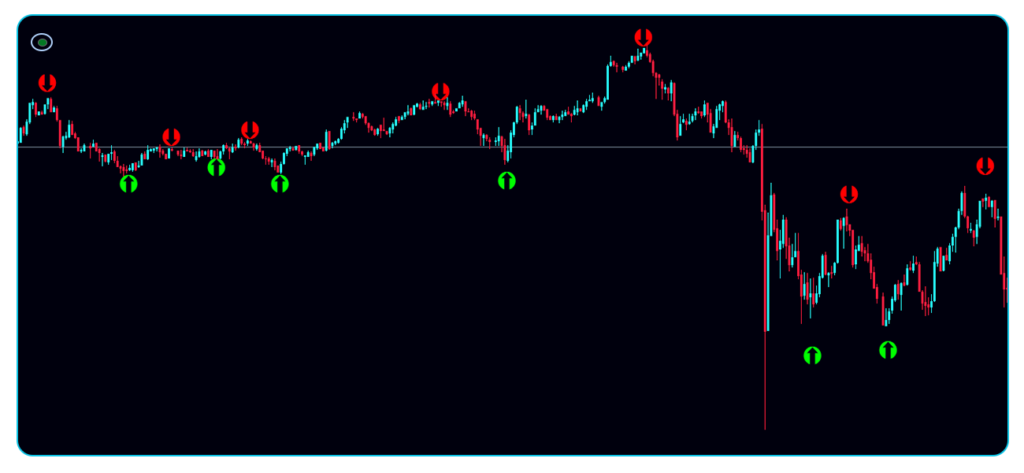
The BD Indicator was built around a simple non-negotiable: once a buy or sell arrow appears on the chart, it stays exactly where it is. No retroactive edits, no vanishing signals, no quiet reshuffling after the fact. What you see in real time is precisely what shows up when you review the chart later — which is the entire foundation of being able to trust a backtest in the first place.
Underneath that simplicity is a neural network-based analysis engine that processes price action, volume, and market sentiment together rather than relying on one static formula applied uniformly across every condition. This is a meaningfully different approach from older tools built around fixed-period calculations like a standard MACD indicator or Bollinger Bands setup, which apply identical math whether the market is trending hard or chopping sideways.
Locked-In Signals You Can Actually Backtest
Because the BD Indicator commits to its arrows the instant they form, running a real, honest backtest becomes possible for the first time with a tool like this. You’re not just verifying that the arrows exist historically — you’re verifying that they would have appeared at that exact moment in real time, which is the only kind of backtest that actually predicts future performance with any reliability.
This is also the standard we hold every tool to before recommending it, and it’s laid out in detail in how we test indicators and robots, which walks through the specific process used to separate genuinely non-repainting tools from ones that only claim to be.
Clean, Chart-Based Signals Without the Clutter
The arrows themselves sit directly on the price chart rather than in a separate sub-window, which keeps the read simple — up arrow, down arrow, done. For traders who like to layer in confirmation, pairing the BD Indicator’s signals with something like the ADX indicator to confirm trend strength before acting on an arrow tends to filter out a good portion of the weaker setups.
Multi-Channel Alerts for Signals That Don’t Get Missed
A locked-in signal doesn’t help much if you’re away from the screen when it fires. The BD Indicator handles this with alerts delivered both through the MT4 platform directly and via email, so a buy or sell signal forming mid-afternoon doesn’t just sit there unnoticed until you happen to glance back at the chart. For traders juggling a day job or multiple open positions across pairs, that redundancy tends to matter more in practice than it sounds like on paper.
What Traders Are Actually Doing With It
The traders getting the most consistent mileage out of the BD Indicator aren’t treating every arrow as an automatic trade. A workable approach looks like this: the arrow flags a directional bias, a quick cross-check against recent support or resistance confirms the setup isn’t fighting an obvious structural level, and only then does a position get sized and opened with a predefined stop already in place.
This kind of layered decision-making solves a problem that shows up constantly in forex trading — emotional entries driven by fear of missing a move rather than an actual confirmed setup. When the signal itself is generated by a consistent, systematic process rather than gut feeling, it’s considerably easier to follow a plan instead of chasing price after the fact.
A Useful Learning Tool for Newer Traders
For traders still building an eye for price action, watching how the BD Indicator’s arrows behave across different market conditions — without necessarily trading every single one — can genuinely accelerate the learning curve. You start noticing which conditions produce clean, reliable signals and which produce weaker, more ambiguous ones, and that pattern recognition carries over into every other part of your trading, not just this one tool.
Where This Fits Alongside Other Signal Tools
Buy/sell arrow indicators are just one piece of a broader signal ecosystem that includes things like forex signals services and best forex signals providers that deliver trade ideas directly rather than requiring you to interpret a chart yourself. The BD Indicator occupies a useful middle ground — you still get a clear, unambiguous signal, but it’s generated directly on your own charts in real time rather than relayed through a third party with its own delay built in.
Traders also running automated systems through MT4 expert advisors sometimes use the BD Indicator’s non-repaint arrows as a manual confirmation layer before letting an EA execute, which adds a human sanity check without slowing down the overall process significantly.
Ready to Test It Yourself?
If the repaint problem has cost you trades before, the fastest way to know whether the BD Indicator solves it for your own trading style is to buy the BD Indicator here and run it on a demo account across a handful of different sessions and market conditions. Watching how the arrows hold up in real time, without editing themselves after the fact, is the single best way to build genuine confidence in any signal tool before committing real capital to it.
Frequently Asked Questions
How do I confirm a buy/sell indicator isn’t repainting? Run it live on a demo account and compare the signals you see in real time against what the chart shows when you scroll back later. If nothing has shifted or disappeared, the non-repaint claim holds.
Can the BD Indicator replace manual chart analysis entirely? It’s best used as a decision-support layer rather than a full replacement — cross-checking its arrows against support, resistance, or a secondary indicator produces more consistent results than trading signals in total isolation.
Where can I purchase the BD Indicator? You can buy it directly here and start applying it to your own MT4 charts right away.
Is a non-repaint indicator automatically more profitable? Not automatically — non-repaint status means the signal is trustworthy and testable, but profitability still depends on how the tool is used alongside proper risk management and trade selection.
Final Thoughts
A genuinely non-repainting buy/sell signal indicator is rarer than the marketing around most MT4 tools would suggest, and that scarcity is exactly why it’s worth verifying the claim yourself rather than taking it at face value. The BD Indicator’s locked-in arrows, AI-driven analysis, and dual-channel alerts make it one of the more transparent options in this space — but as always, the real test happens on your own charts, under your own trading conditions.
If you’re ready to see how it holds up, grab the BD Indicator here and put it through a proper demo run before going live. And for a deeper look at how signal reliability gets evaluated across the board, our guide on forex signals is a solid next stop.