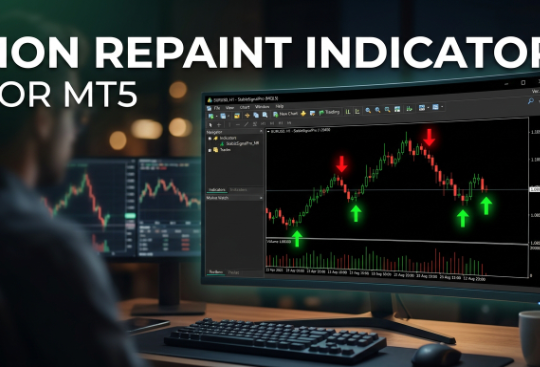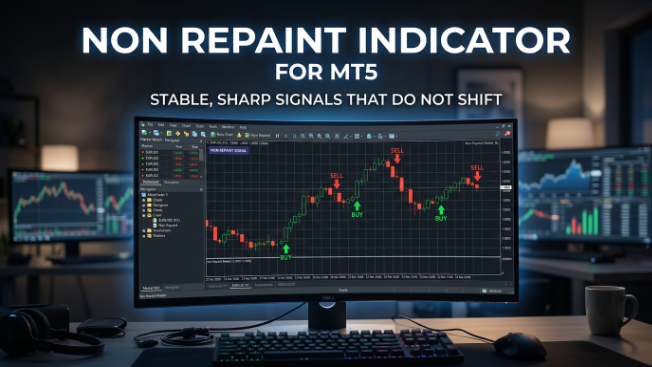
Calling a trend reversal is one of the most valuable things a trading tool can do, and also one of the easiest things for a tool to fake after the fact. That combination makes reversal indicators a particularly risky category to trust blindly. This article breaks down what a genuine non-repaint trend reversal indicator for MT5 actually needs to demonstrate, why reversal calls are especially prone to repainting, and how the BD Indicator approaches the problem.
Why Reversal Signals Are the Hardest to Trust

Trend-following signals are relatively forgiving — if a moving average crossover fires a bit late, you still catch most of the move. Reversal signals don’t have that cushion. A reversal call is only valuable if it fires right at or near the actual turning point, which means the margin for error is razor-thin, and the temptation for indicator developers to quietly “improve” that timing using future data is significant.
This is exactly where repainting does the most damage. A repainting reversal indicator can display an arrow precisely at the top of a swing high or the bottom of a swing low when you scroll back through history, because it recalculated with the benefit of already knowing what happened next. In real time, that same indicator never actually catches the turn with that kind of precision — it just looks like it does after the fact, which is a meaningfully different thing.
The Confirmation Delay Trade-Off
Even non-repainting reversal tools face a real trade-off between speed and reliability. A signal that confirms too fast will generate a lot of false reversal calls during normal pullbacks that aren’t actual trend changes. A signal that waits too long to confirm might be accurate, but by the time it fires, a meaningful chunk of the reversal move has already happened. Finding a tool that balances this trade-off well is genuinely difficult, which is part of why the category is so crowded with underperforming options despite how many MT5 indicators claim to solve it.
How the BD Indicator Handles Reversal Detection
The BD Indicator locks in its directional signals the instant they form, which is the non-negotiable baseline for any reversal tool worth using. Once an arrow appears flagging a potential turn, it holds that position permanently on the chart — there’s no quiet recalculation later that shifts the signal to line up more perfectly with what actually happened.
What makes it particularly relevant to reversal detection specifically is the AI layer underneath. Rather than relying on a single fixed threshold — the way a classic parabolic SAR indicator flips based on a static acceleration factor, or the way Bollinger Bands signal a reversal purely off a fixed standard deviation touch — the BD Indicator weighs price action, volume, and sentiment together, adjusting how much confirmation it requires based on current market conditions. That adaptability matters more for reversals than almost any other signal type, because what counts as a legitimate turn in a calm, low-volatility market looks completely different from what counts as one during a high-volatility news session.
Filtering Real Reversals From Ordinary Pullbacks
One of the more practical benefits of an adaptive, AI-driven approach is a reduction in false positives during normal trend continuation pullbacks — the kind of temporary pause that looks like a reversal in the moment but resolves back in the original direction shortly after. A rigid, fixed-formula tool tends to fire on every pullback regardless of context. An adaptive system has a better shot at distinguishing a genuine structural change from ordinary market noise, though this is a claim worth testing against your own preferred pairs and timeframes rather than accepting outright.
Confirming Reversal Strength With Trend Tools
Pairing the BD Indicator’s reversal arrows with a trend-strength confirmation tool like the ADX indicator adds a useful second layer — a reversal signal that coincides with a weakening ADX reading on the prior trend carries more weight than one that fires while the existing trend is still showing strong directional momentum. Similarly, checking volatility context through the average true range indicator helps set realistic stop distances around a reversal entry, since the market has often just shifted its volatility profile at exactly the moment a real reversal begins.
Alerts That Don’t Let a Reversal Slip By
Reversal windows can be narrow, and missing the initial confirmation often means entering the new trend well after the best part of the move has already happened. The BD Indicator’s alert system covers both in-platform notifications and email, which matters considerably for reversal trading specifically — a turn that develops while you’re away from the screen still reaches you in time to act on it rather than showing up as a missed opportunity hours later.
Building a Reversal Strategy Around the Signal
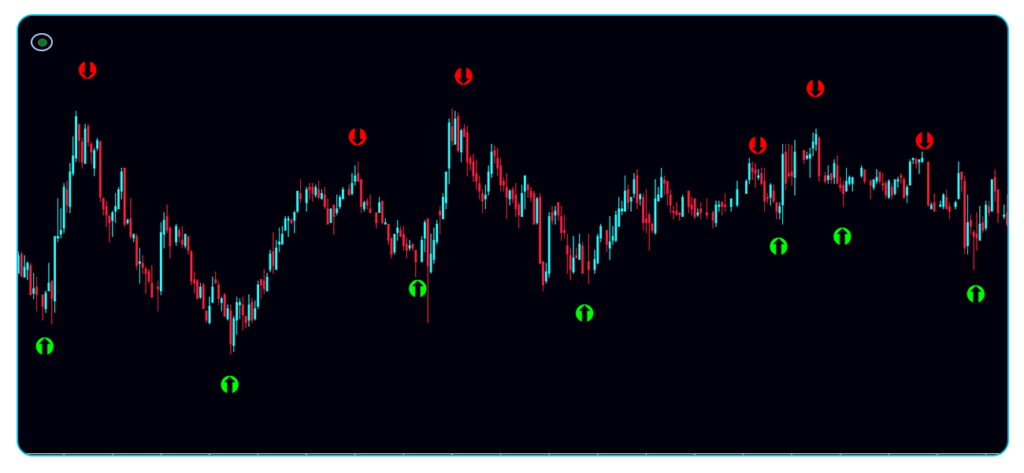
The traders getting the most consistent results with reversal indicators generally aren’t trading every signal as an immediate market order. A more disciplined structure looks like this: the BD Indicator flags a potential turn, a quick check against recent support or resistance confirms the level makes structural sense as a genuine turning point, and only then does the trade get entered — often with a slightly wider stop than a trend-continuation trade would use, given the added uncertainty inherent to catching reversals.
This kind of layered confirmation addresses one of the more expensive mistakes traders make in forex trading — jumping on a reversal signal the instant it appears without checking whether the broader structure actually supports a turn at that specific level. A reversal call at a random price point carries far less weight than one that coincides with an established support or resistance zone.
Why Reversal Trading Rewards Patience Specifically
Compared to trend-following, reversal trading tends to punish impatience more severely. Entering too early, before the turn is actually confirmed, means risking a position against a trend that simply hasn’t finished yet. Waiting for the BD Indicator’s locked-in signal, rather than trying to anticipate the turn ahead of time based on gut feeling, tends to produce a meaningfully better risk-to-reward outcome over a large enough sample of trades.
Verify the Non-Repaint Claim on Reversal Signals Specifically
Reversal indicators deserve even more scrutiny than trend-following tools before you trust them, precisely because the repaint temptation is strongest in this category. Run the BD Indicator forward on a demo account and compare the reversal signals you see forming in real time against what the same chart shows when reviewed later. If nothing has shifted, relocated, or vanished, the non-repaint claim holds up under the exact conditions where it matters most. This mirrors the standard applied in how we test indicators and robots, and it’s worth holding every reversal tool to that bar before trading it live.
Where Reversal Signals Fit in a Broader Toolkit
Reversal-specific tools work best as one component of a wider signal approach rather than a standalone system. Services like forex signals can provide broader market context around major structural levels, which pairs well with a chart-based reversal indicator generating entries directly on your own timeframe rather than relying entirely on third-party trade ideas with their own inherent delay.
Ready to Test It on Your Own Reversal Setups?
If reversal signals have burned you before with calls that looked flawless in hindsight but never quite materialized live, the clearest way to know whether the BD Indicator solves that is to buy the BD Indicator here and run it forward on a demo account across a range of trending and ranging conditions. Watching how it handles genuine reversals versus ordinary pullbacks, in real time, is the only real way to build confidence before trading it with actual capital.
Frequently Asked Questions
Why are reversal indicators more prone to repainting than trend-following tools? Reversal calls require pinpoint timing at the exact turning point, which creates a strong incentive for indicators to quietly adjust their signal after the fact to look more accurate than they actually were in real time.
How do I know if the BD Indicator’s reversal signal is genuine and not a false pullback? Cross-checking the signal against a trend-strength tool like ADX or a known support and resistance level adds meaningful confirmation before treating a signal as a real structural reversal.
Where can I purchase the BD Indicator for MT5? You can buy it directly here and start applying it to your reversal setups right away.
Should I use a wider stop-loss on reversal trades compared to trend trades? Many traders do, given the added uncertainty in catching a turn precisely, though the right stop distance ultimately depends on your own risk tolerance and current market volatility.
Final Thoughts
Reversal signals carry the highest reward potential of any signal type, and correspondingly the highest risk of being fooled by a tool that only looks accurate in hindsight. The BD Indicator’s locked-in signals, adaptive AI analysis, and dual-channel alerts give it a genuine shot at handling this difficult category properly — but as with any reversal tool, the real proof comes from watching it perform forward, in real time, on your own charts.
If you’re ready to see how it handles your own preferred markets, grab the BD Indicator here and run it through a proper forward test before going live. For more on building a broader signal strategy around reversal setups, our guide on forex signals is worth exploring next.